Research
My research draws on philosophical tools and my experience as a litigator to analyze questions regarding public law, precedent, and interpretation. I am currently working on projects that address: a logical fallacy that infects the leading justifications for originalism; the import of legal positivism for debates over legal interpretation; and the independence of textualism in statutory interpretation from originalism in constitutional interpretation.
Two themes run throughout much of my work. The first is the relevance of philosophy to debates over legal interpretation—and particularly to clarifying how those debates can most productively move forward. And the second is that there are distinct normative stakes involved in interpreting different kinds of legal texts under different circumstances, suggesting that a complete theory of legal interpretation must be complex and multifaceted.

You can learn more about my publications and works in progress below.
Publications

The Plain-Meaning Fallacy
Boston College L. Rev. (forthcoming)
The leading justifications for originalism all commit the same fallacy: the plain-meaning fallacy. There are compelling reasons to enforce the Constitution’s plain—as in indisputable—original meaning. But there is little to no reason to enforce the Constitution’s less than plain original meaning. The problem is that justifications for originalism help themselves to the former set of reasons to justify doing the latter. That is the plain-meaning fallacy: assuming without argument that the benefits of enforcing plain original meaning extend to enforcing less than plain original meaning too.

What Are We Debating When We Debate Legal Interpretation?
B.U. L. Rev. (forthcoming)
Debates over legal interpretation, such as those between textualists and purposivists or originalists and living constitutionalists, are familiar and longstanding. Yet there remains disagreement over what these debates are really about—over what interpretive theories aim to achieve. Do interpretive theories aim to grasp what legal texts communicate? Do they aim to explain how legal texts make law? Are they heuristics for discerning the law? Or are they instructions for how to go on when the law runs out? Answering this “meta-interpretive” question about what we are debating when we debate legal interpretation is key to making progress in these debates.
This Article frames the meta-interpretive question and explores how a widely held view in general jurisprudence—Hartian Positivism—answers it. Hartian Positivism holds that what counts as law in any jurisdiction depends on what officials in that jurisdiction generally accept and treat as law. If Hartian Positivism is right, then interpretive theories are primarily about interpretation in a remedial sense: they concern how legal actors should exercise discretion when the law runs out—how they should fill in the law’s gaps. This remedial answer, in turn, has important implications for how judges and theorists should (and should not) defend their preferred interpretive theories.

In What Sense Is Law a Moral Practice?
17 Wash. U. Jur. Rev. 87 (2024)
Scott Hershovitz’s book Law Is a Moral Practice argues that law is, well, a moral practice—though what that means is less than clear. This Review takes up the book’s titular claim and considers the senses in which that claim is true and those in which it is false or at least controversial. To that end, the Review first differentiates several ideas that Hershovitz appears to lump together under the slogan “law is a moral practice.” One of those ideas is the “one-system view” associated with Ronald Dworkin’s late work, on which law is a branch of morality, such that legal norms are a subset of moral norms. The Review then reconstructs Hershovitz’s argument for the one-system view and critically examines the argument’s premises, ultimately concluding that the argument is unsuccessful. Nevertheless, the argument is worth considering for, among other reasons, the light it sheds on general jurisprudence’s methodology.
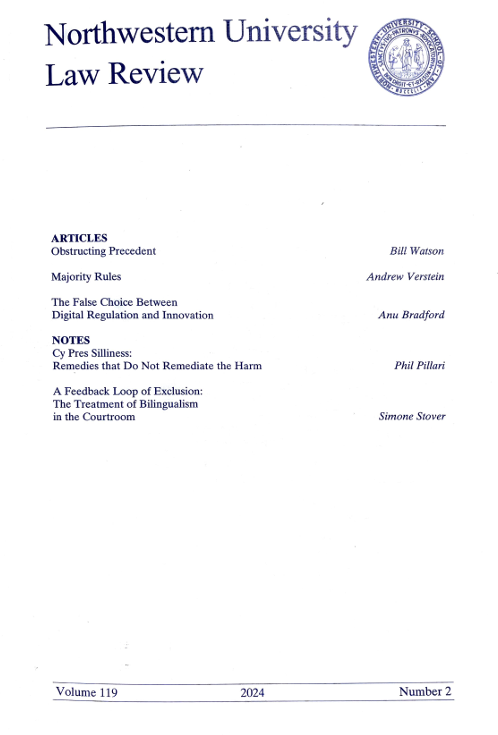
Obstructing Precedent
119 Nw. U. L. Rev. 259 (2024)
Critics of the Supreme Court sometimes accuse the justices of disrespecting or being unfaithful to precedent—of severely undermining certain precedents while leaving them formally in place. Yet it remains unclear what exactly these criticisms mean or why they point to anything objectionable. This Article proposes that critics are often drawing attention to a particular practice: obstructing precedent. A better grasp of what obstructing precedent is and when it is legitimate is an important prerequisite to understanding the Roberts Court’s treatment of precedent in a wide range of cases.
Roughly put, a court obstructs precedent when it refuses to cooperate with its prior self in building a coherent body of law. The court reaches a holding in the instant case that cannot be justified by the same rationale—the same weighting of values or purposes—as justified its holding in the precedent case. As a result, the same institution seems over time to speak not with one voice but with multiple discordant voices that reflect no unified political vision. Over the last few years, the Roberts Court has repeatedly obstructed precedent in just this sense in cases spanning diverse areas of the law.
Those who criticize the justices for disrespecting or being unfaithful to precedent usually imply that the justices have thereby acted illegitimately. But that conclusion is too quick. There is nothing inherently illegitimate about obstructing precedent, either legally or politically; obstructing precedent can sometimes be a salutary means of gradual change. At the same time, the Court’s aggressive pattern of obstructing precedent in recent years is cause for concern, given how that pattern undermines the impersonality of the justices’ reasoning and risks further eroding public trust in the Court.
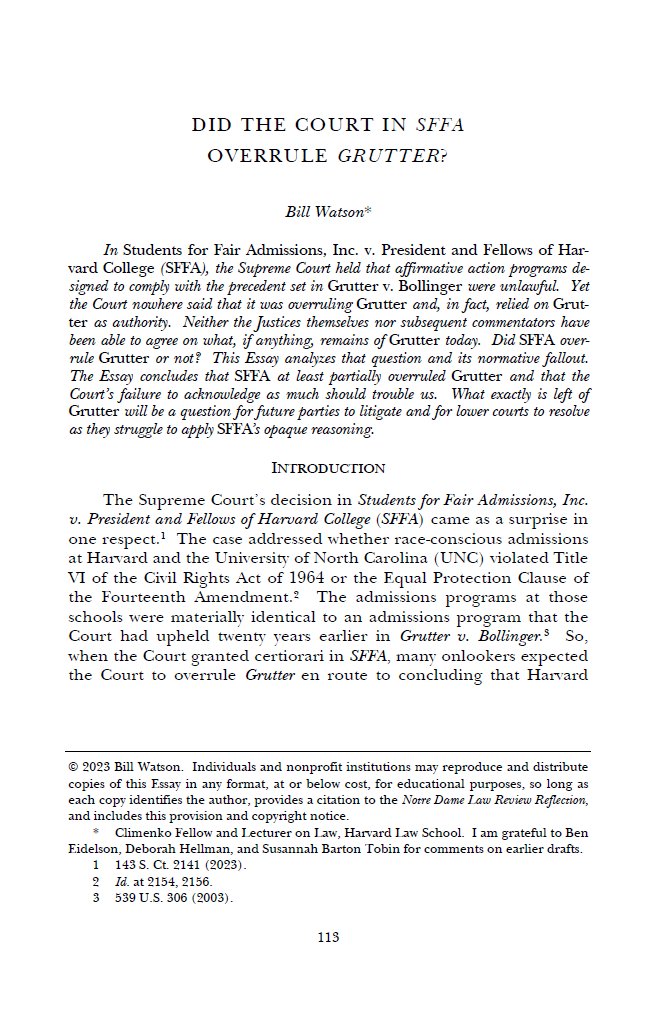
Did the Court in SFFA Overrule Grutter?
99 Notre Dame L. Rev. Reflection 113 (2023)
In Students for Fair Admissions, Inc. v. President and Fellows of Harvard College (SFFA), the Supreme Court held that affirmative action programs designed to comply with the precedent set in Grutter v. Bollinger were unlawful. Yet the Court nowhere said that it was overruling Grutter and, in fact, relied on Grutter as authority. Neither the Justices themselves nor subsequent commentators have been able to agree on what, if anything, remains of Grutter today. Did SFFA overrule Grutter or not? This Essay analyzes that question and its normative fallout. The Essay concludes that SFFA at least partially overruled Grutter and that the Court’s failure to acknowledge as much should trouble us. What exactly is left of Grutter will be a question for future parties to litigate and for lower courts to resolve as they struggle to apply SFFA’s opaque reasoning.
Explaining Legal Agreement
14 Jur. 221 (2023)
Legal theorists tend to focus on disagreement over the law, and yet a theory of law should also explain why lawyers and judges agree on the law as often as they do. To that end, this article first pins down a precise sense in which there can be pervasive agreement on the law. It then argues that such agreement obtains in the United States and likely in many other jurisdictions as well. Finally, it contends that Hartian Positivism offers a straightforward explanation of this phenomenon and, indeed, a better explanation than rival theories, like Ronald Dworkin’s Law as Integrity or Scott Shapiro’s Planning Theory. Given the ubiquity of legal agreement, Hartian Positivism’s explanatory superiority in this regard is a strong, albeit still not dispositive, consideration in its favor. The broader lesson is that theories of law should give greater priority to explaining legal agreement than many theories now do.

Metalinguistic Negotiation in Legal Speech
42 L. & Phil. 487 (2023)
This paper examines the role of metalinguistic negotiation in lawyers’ and judges’ speech about the law. A speaker engages in metalinguistic negotiation when the speaker uses a term to advocate for what that term should mean or how it should be used relative to context. While I doubt that legal practitioners employ metalinguistic negotiation in the ways that David Plunkett and Tim Sundell have proposed, it is plausible that practitioners do so in another way. Specifically, I contend that lawyers and judges sometimes use key terms in legal interpretation—e.g., “plain,” “meaning,” or “holding”—to advocate for what those terms should mean or how courts should use them in adjudication. This suggests an intriguing role for metalinguistic negotiation in legal argumentation, one that could shed light on practitioners’ disputes in a range of cases dealing with constitutional, statutory, or common-law interpretation.

How to Answer Dworkin’s Argument from Theoretical Disagreement Without Attributing Confusion or Disingenuity to Legal Officials
36 Can. J. L. & Jur. 215 (2023)
Ronald Dworkin’s argument from theoretical disagreement remains a pressing challenge for legal positivists. In this paper, I show how positivists can answer Dworkin’s argument without having to attribute confusion or disingenuity to legal officials. I propose that the argument rests on two errors. The first is to assume that positivism requires legal officials to converge on precise grounds of law when convergence on more general grounds will do. The second is to construe judicial speech too literally. If we pay attention to the pragmatics of judicial speech, we see that judges do not disagree over what the grounds of law are; they at most disagree over how courts should proceed when agreed-upon, though imprecise, grounds of law underdetermine what the content of the law directs in the case at hand.

In Defense of the Standard Picture: What the Standard Picture Explains that the Moral Impact Theory Cannot
28 Legal Theory 59 (2022)
How do legal texts determine legal content? A standard answer to this question— sometimes called “the standard picture”—is that legal texts communicate something and what they communicate is identical to legal content. Mark Greenberg criticizes the standard picture and offers in its place his own “moral impact theory.” My goal here is to respond to Greenberg by showing how the standard picture better explains legal practice than the moral impact theory does. To that end, I first clarify certain aspects of the moral impact theory. I then critique the theory, focusing on its inability to explain (i) why practitioners reason about legal content as they do and (ii) why they agree on legal content as often as they do. Finally, I refine the standard picture and demonstrate how it explains what the moral impact theory cannot.
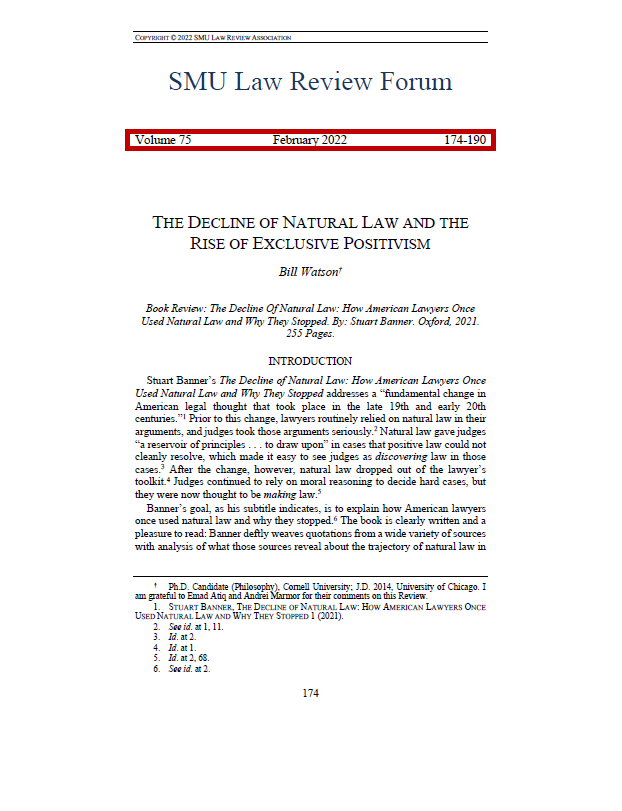
The Decline of Natural Law and the Rise of Exclusive Positivism
75 SMU L. Rev. F. 174 (2022)
Stuart Banner’s The Decline of Natural Law: How American Lawyers Once Used Natural Law and Why They Stopped examines a major change in American legal thought that occurred between the nineteenth and twentieth centuries. Prior to this change, lawyers regularly relied on natural law; afterwards, natural law dropped out of the lawyer’s toolkit. In this review of Banner’s book, I argue that his account of the decline of natural law has important implications for both the substance and methodology of general jurisprudence. On the one hand, his account provides a plausible history of how American lawyers’ concept of law gradually came to cohere with exclusive positivism. On the other hand, his account suggests that our concept of law is more parochial than it is sometimes assumed to be, thus highlighting the limits of conceptual analysis for general jurisprudence.

Textualism, Dynamism, and the Meaning of “Sex”
2022 Cardozo L. Rev. De Novo 41 (2022)
A recent article by William N. Eskridge, Brian G. Slocum, and Stefan Th. Gries critically examines textualism, both in general and as applied in Bostock v. Clayton County. This Essay makes three points in reply. First, the authors criticize strawman versions of textualism that no mainstream legal interpreter claims to hold. Second, the authors’ examples of “societal dynamism” do not put any pressure on textualism properly understood. And third, the authors’ corpus-linguistics analysis of the word “sex” is, from a textualist perspective, irrelevant to the issue in Bostock.

Literalism in Statutory Interpretation: What Is It and What Is Wrong with It?
2021 U. Ill. L. Rev. Online 218 (2021)
In two decisions—Bostock v. Clayton County and Niz-Chavez v. Garland—a majority of the Supreme Court claimed to apply a textualist approach to statutory interpretation, and a dissent charged the majority with applying “literalism” instead. But what is literalism and what, if anything, is wrong with it? This Essay borrows a few ideas from the philosophy of language to try to pin down a more precise sense in which the majority opinions in Bostock and Niz-Chavez were arguably literalistic. The opinions may have been literalistic in the sense that they failed to consider how context pragmatically enriched what the relevant statutes asserted by fixing the operative sense of a polysemous word. If that is right, then one problem with such a literalist approach is that it pushes controversial interpretive choices underground rather than giving a linguistic (or any other sort of) argument for those choices.
Works in Progress

A paper on why textualists need not, and should not be, originalists
A paper on conceptual analysis and a possible shift in our concept of law over the last two centuries